

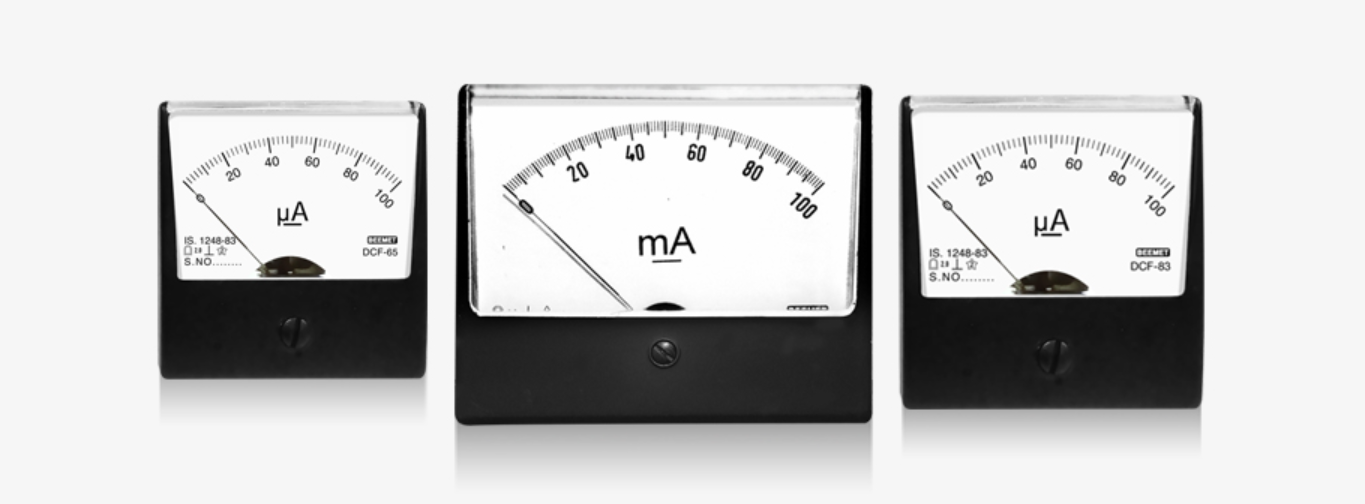
Many electricians and electrical learners often confuse magnetoelectric, electromagnetic, and electrodynamic meters when conducting electrical measurements. These three types are the most classic basic instruments in electrical measurement. Mixing up their working principles, measurement ranges and application scenarios may lead to inaccurate readings and hidden electrical risks.
First comes the magnetoelectric meter, which features the highest precision and sensitivity for DC measurement. It has an intuitive structure with a fixed permanent magnet and a rotatable coil inside. Its working principle is similar to a small electric motor, except that it will not keep rotating but deflect according to the current magnitude. When current flows into the movable coil, the coil is subjected to electromagnetic force in the stable magnetic field and deflects steadily to drive the pointer for readings.
Benefiting from the uniform magnetic field provided by the permanent magnet, the magnetoelectric meter features evenly distributed scales, clear readings and tiny errors, ideal for precision measurement. However, it is limited to measuring direct current only. If connected to alternating current, the current direction keeps changing, causing the pointer to shake continuously without stable readings and finally return to zero. This type of meter is widely used in the DC gear of multimeters and laboratory DC current & voltage detection, serving as a high-precision instrument dedicated to DC measurement.
The second type is the electromagnetic meter, the most common instrument used in industrial sites. Different from the magnetoelectric structure, the electromagnetic meter has no permanent magnet. The measured current flows through a fixed coil to generate a magnetic field, magnetizing the iron sheet inside. Attraction or repulsion between iron sheets drives the pointer to deflect. Since its principle does not rely on a fixed magnetic field, the coil can produce stable magnetization effect no matter DC or AC power is supplied, enabling both AC and DC measurement.
This instrument boasts simple structure, sturdiness, shock resistance and strong overload capacity, well suited for construction sites, power distribution cabinets and switchgear. Most AC ammeters and voltmeters we see daily are electromagnetic meters. Its only drawback is uneven scales, which become sparser at higher ranges, requiring careful reading. Overall, the electromagnetic meter stands out for great versatility and robustness, acting as the primary measuring instrument in industrial measurement.
The last one is the electrodynamic meter, the most versatile precision instrument among the three. It removes the permanent magnet and adopts two matched coils: a fixed coil and a movable coil. When both coils are energized, they generate independent magnetic fields respectively. Mutual force between the two magnetic fields pushes the movable coil to deflect. The deflection of the pointer is proportional to the product of current in the two coils. Therefore, the electrodynamic meter can not only measure voltage and current, but also accurately measure electric power, forming the core working principle of power meters and watt-hour meters.
It supports both AC and DC measurement with high precision and stable data, classified as a precision instrument for electrical measurement. On the downside, it has a more complex structure, higher cost and poor vibration resistance, so it demands stricter operating environments. It is mostly applied in laboratory precision testing, electrical parameter measurement and power metering scenarios.
To sum up, the three classic electrical meters have their own strengths and clear divisions:
- Magnetoelectric meters deliver high-precision DC measurement and are preferred for accurate readings;
- Electromagnetic meters are durable and universal, fit for most industrial AC measurement tasks;
- Electrodynamic meters feature comprehensive functions and serve as core equipment for power measurement and precision detection.
Mastering the principles and applicable scenarios of these instruments lays a solid foundation for learning electrical measurement and improving practical operation ability. You can quickly select the right instrument during instrument specification for electrical projects.
If you have questions about electrical project design, cable selection or electrical measurement schemes, feel free to contact our technical team for professional support.

