

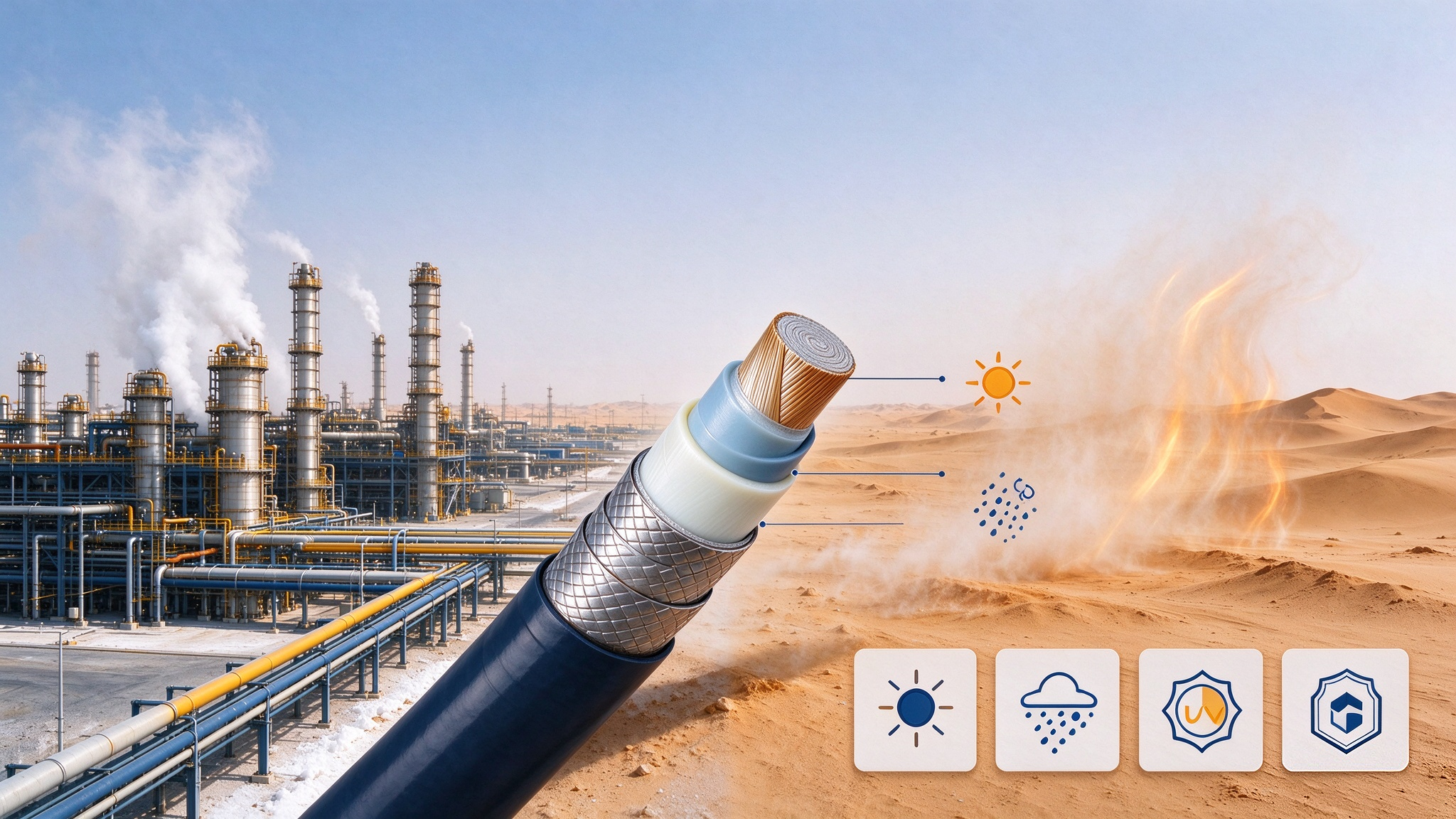
Saudi Arabia, UAE, Qatar and other Gulf regions suffer from extreme heat, intense UV radiation and sand abrasion. Coastal sites additionally face salt spray corrosion. Many engineering teams adopt cable standards designed for temperate climates, which often leads to sheath cracking, premature insulation ageing and insufficient current-carrying capacity, resulting in costly rework. This guide serves as a practical reference for EPC contractors, MEP subcontractors and project buyers.
Key Hazards of Desert Conditions in the Middle East
Surface temperatures can exceed 50°C in summer, so derating is mandatory for cables installed on open-air cable trays. Strong ultraviolet radiation degrades standard outer sheaths rapidly. Continuous sand erosion, combined with thermal cycling from large day-night temperature swings, accelerates cable ageing. Salt mist in coastal locations will corrode armour layers.
Core Selection Principles & Installation Guidance
70℃ PVC cables are not suitable for outdoor exposure. 90℃ XLPE YJV cables work for shaded locations. For overhead lines and solar farms, 105℃ / 125℃ high-temperature XLPE or LSZH cables are preferred; fire-resistant LSZH cables are required for fire protection circuits. Rated ampacity on datasheets is tested at a base temperature of 30°C. Ampacity derating must be calculated for high ambient temperature and multi-cable dense installation. Outdoor sheaths shall incorporate UV stabilisers, with modified PE or LSZH as preferred materials. SWA (steel wire armour) is used for direct burial; STA (steel tape armour) is recommended for severe sand areas, and extra anti-corrosion treatment is needed for armour on coastal projects. High-temperature insulation paired with UV-resistant sheaths applies to open trays and PV sites. Direct-burial desert cables require anti-corrosion armour plus ampacity derating. Standard YJV and WDZN-YJV are acceptable for indoor substations. UV-modified RVVP screened cables are used for instrument and signal circuits.
Common Pitfalls & Recommended Cable Types
Typical mistakes: upsizing conductors without derating, using ordinary PVC sheaths outdoors, applying identical protection schemes for inland desert and coastal sites, mixing flame-retardant and fire-resistant cables, and overlooking GSO / SASO certifications which cause inspection failure. Recommended types: WDZN-YJV, UV-modified YJV, YJV22 / YJV32 armoured cables, UV-modified RVV / RVVP. Always request UV ageing test reports for all outdoor cables.
The core rule for Middle East cable selection: match the operating environment first, then calculate ampacity. Focus on high-temperature derating, UV-resistant sheaths, sand / salt protection and regional certifications. If you have an ongoing Gulf EPC project, share installation method, maximum ambient temperature, coastal condition and load data, and we will deliver custom cable recommendations and quotations.

